About GridFit — block puzzle game
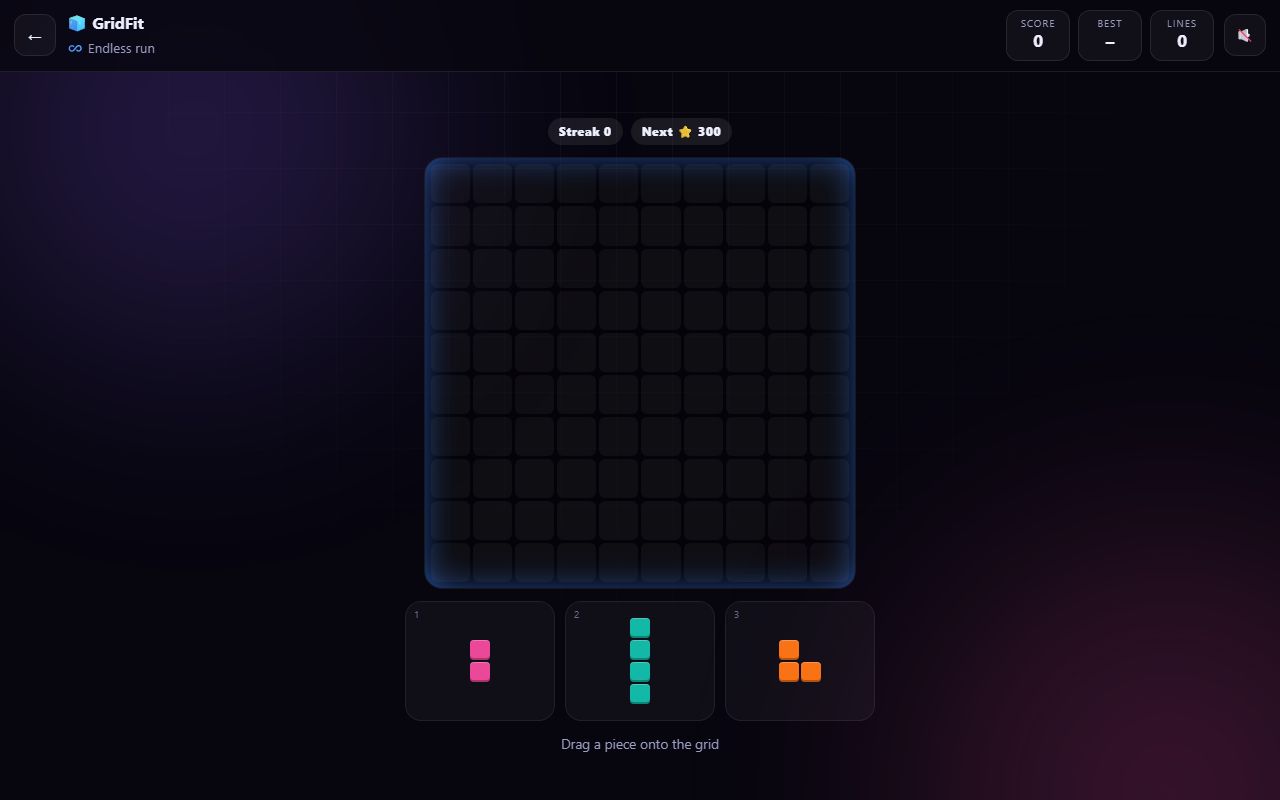
GridFit is an endless block-placement puzzle. Drag three pieces at a time onto a 10×10 grid and clear full rows and columns to keep space open. There are no levels — one run lasts until no piece fits, and your score goes on the leaderboard.
Score as many points as possible in a single run. Every cell you place is worth 1 point, and every full row or column you complete clears and scores a bonus. The run ends when none of the pieces left in your tray can be placed anywhere on the grid. Reach 300 points for 1 star, 1,000 for 2 stars and 2,500 for 3 stars.
How to play
- You get a tray of three pieces made of 1 to 9 cells — lines, squares, L-shapes, T-shapes and more. Pieces cannot be rotated.
- Drag any piece onto an empty spot on the 10×10 grid. It only drops where every one of its cells fits.
- When a whole row or a whole column is filled, it clears and you score bonus points.
- Clearing two or more lines with one piece is a combo: points grow with the square of the lines cleared.
- Clearing lines on back-to-back placements builds a streak, adding +25% to each clear per streak step.
- Once all three pieces are placed you get a new set of three.
🎮 Controls
| Drag a piece (touch or mouse) | Pick up a piece from the tray and drop it on the grid. On touch screens the piece floats above your finger so you can see where it lands. |
| Ghost preview | While dragging, a coloured ghost shows exactly where the piece will go; rows and columns that would clear glow. |
| 1 / 2 / 3 | Select a tray piece with the keyboard. |
| Arrow keys | Move the selected piece around the grid. |
| Enter | Place the selected piece at the cursor. |
| Esc | Cancel the keyboard selection. |
📈 How the run gets harder
Warm-up (0–1,000 points) — Small pieces — singles, dominoes, short lines and small L-shapes — appear most often. Your first set of three is always fully placeable.
Building (1,000–3,000 points) — As your score rises, medium pieces like 2×2 squares, T-shapes and four-long lines become more common and small pieces less so.
Blockers (3,000+ points) — At 3,000 points a few grey blocker cells drop onto empty squares, then again at later milestones that move further apart each time. Blockers behave like filled cells and disappear when their row or column clears. They never complete a line by themselves.
Expert (6,000+ points) — Big and awkward pieces — five-long lines, large L-shapes, 2×3 and 3×3 blocks — become frequent, and each blocker drop adds an extra blocker. Survival depends on keeping open space.
💡 Top tips
- Keep the middle of the grid open — big pieces need room, and the centre is the hardest area to refill.
- Build against the walls and corners first; edges give pieces something to lock against.
- Look at all three pieces before placing the first one, and make sure the other two will still fit afterwards.
- Place the biggest or most awkward piece first while you still have space for it.
- Watch the glowing rows and columns in the preview: a placement that clears lines is usually worth taking.
- Avoid leaving single empty cells surrounded by filled ones — only a 1-cell piece can fill them.
❓ GridFit FAQ
Does GridFit have levels?
No. GridFit is an endless game: one run lasts until none of your pieces can fit on the grid. Your best score is saved and shown on the leaderboard.
Can I rotate pieces?
No — pieces are placed exactly as shown in the tray. Plan for their shape before you place anything.
When does the game end?
As soon as none of the pieces left in your tray fit anywhere on the grid. Pieces that cannot fit are greyed out with a ✖ so you can see it coming.
How do combos and streaks work?
Clearing several lines with one piece scores 10 × lines² points. Clearing lines on back-to-back placements builds a streak that adds 25% per step to each clear.
What are the grey striped blocks?
Blockers. They drop onto empty cells after score milestones, starting at 3,000 points. They count as filled cells and are removed when their row or column clears.
Is the Daily Challenge different?
The rules are the same, but every player gets the same sequence of pieces that day, so scores are directly comparable.